
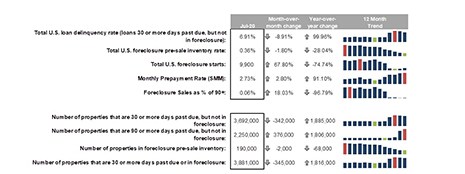
Black Knight, Jacksonville, Fla., said its “First Look” Mortgage Monitor showed while overall delinquencies continued to show improvement, serious delinquencies rose by 376,000 and are now up more than 1.8 million from their pre-pandemic levels.
Category: News and Trends

July Existing Home Sales Ride the Wave
Existing home sales surged by a record 24.7 percent in July, the second straight double-digit monthly gain, the National Association of Realtors reported yesterday.

TransUnion: Consumer Credit Market Withstands Coronavirus Challenges
TransUnion, Chicago, reported the total percentage of accounts in “financial hardship” status dropped during July for mortgages, auto loans, credit cards and personal loans – marking the first such decrease since the start of the COVID-19 pandemic.
Longer-Term Challenges to Multifamily Risk Outlook Emerge
The multifamily sector made it through the first half of the year with less turmoil as some anticipated. But the pandemic could create longer-term challenges for the sector, said Phoenix American, San Rafael, Calif.
ATTOM: Refis Make Up 2/3 of 2nd Quarter Loans, Highest Level in 7 Years
ATTOM Data Solutions, Irvine, Calif., released its second-quarter U.S. Residential Property Mortgage Origination Report, showing 1.69 million refinance mortgages secured by residential properties (1 to 4 units) originated, up nearly 50 percent from the prior quarter and more than 100 percent from a year ago, to the highest level in seven years.

CFPB Extends Comment Period on ECOA/Reg B RFI to Dec. 1
Bowing to requests by the Mortgage Bankers Association and other industry trade groups, the Consumer Financial Protection Bureau on Aug. 19 said it will provide an additional 60 days for public comment on its Request for Information on expanding access to credit through Regulation B, which implements the Equal Credit Opportunity Act.
MBA: Mortgage Delinquencies Spike in Second Quarter
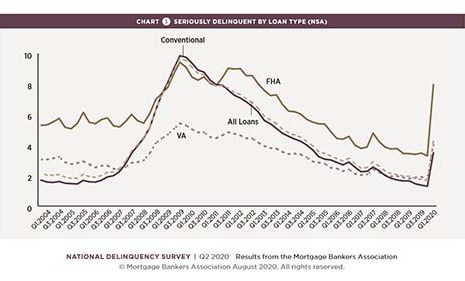
The Mortgage Bankers Association’s released its Second Quarter National Delinquency Survey, showing the delinquency rate for mortgage loans on one-to-four-unit residential properties increased to a seasonally adjusted rate of 8.22 percent of all loans outstanding.
CFPB Proposes New Category of Qualified Mortgages
The Consumer Financial Protection Bureau on Aug. 18 issued a notice of proposed rulemaking to create a new category of seasoned qualified mortgages, called “Seasoned QMs,” to “encourage innovation and help ensure access to responsible, affordable in the mortgage credit market.”
MBA: Loans in Forbearance Fall 9th Straight Week
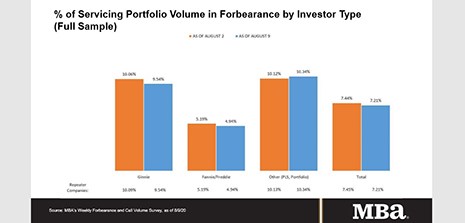
The Mortgage Bankers Association’s latest Forbearance and Call Volume Survey reported loans now in forbearance decreased by 23 basis points to 7.21% of servicers’ portfolio volume the week of Aug. 9 from 7.44% the previous week. MBA estimates 3.6 million homeowners are in forbearance plans.
MBA: Mortgage Delinquencies Spike in Second Quarter
The Mortgage Bankers Association’s released its Second Quarter National Delinquency Survey, showing the delinquency rate for mortgage loans on one-to-four-unit residential properties increased to a seasonally adjusted rate of 8.22 percent of all loans outstanding.