

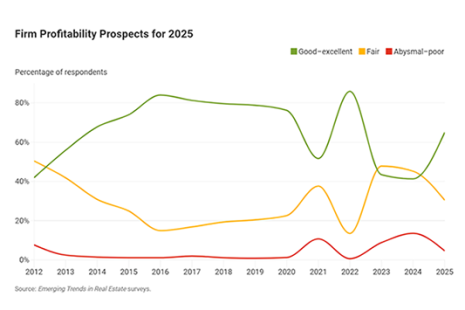
Profitability is under pressure and capital faces greater competition, so real estate investors and operators need to adapt and navigate higher rates and uncertainty, a new report from PwC and ULI says.
Tag: ULI

ULI, Heitman Report: AI Makes Power–not Location–Primary Real Estate Value Driver
Artificial intelligence is reshaping real estate economics and redefining the drivers of long-term value creation, a new report from The Urban Land Institute and Heitman concludes.

PwC, ULI Look at Emerging Trends for 2026
The commercial real estate sector is seeing a renewed focus on core fundamentals and deploying capital into high-growth areas, according to Emerging Trends in Real Estate 2026, from PwC and the Urban Land Institute.
PwC, ULI: Real Estate Confidence Increasing
Real estate industry leaders are more confident now than a year ago, but they remain cautious, according to Emerging Trends in Real Estate 2025, published by PwC and the Urban Land Institute.

ULI: Investors Can Leverage Climate Risk Disclosure Data
The Urban Land Institute, Washington, D.C., said investors can leverage the data resulting from government regulations that require real estate companies to disclose climate-related risks related to their properties and overall business models.

ULI Forecasts Slow GDP Growth in Short Term
The Urban Land Institute, Washington, D.C., predicted positive but slow growth for the U.S. economy until 2025–which should bring a return to stronger growth and average inflation–in its semiannual Real Estate Economic Forecast.

ULI: Office Sector in ‘Full State of Flux’
Offices are here to stay, but the sector is in ‘a full state of flux,’ said the Urban Land Institute, Washington, D.C., and Instant Group, London.
ULI: Zoning for a More Resilient and Sustainable Future
Updating zoning regulations can increase housing attainability, reduce carbon emissions, promote social equity and improve community health, reported the Urban Land Institute, Washington, D.C.