

Industry Panel Tackles AI Use Cases, What’s Next
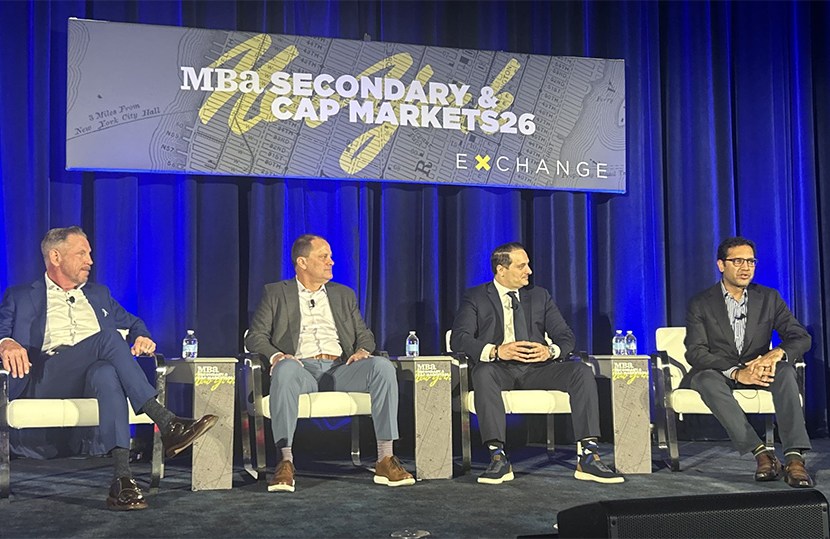
(From left: Moderator John Hedlund, Steven Schwalb, Matthew VanFossen and Vishal Garg, by Anneliese Mahoney)
NEW YORK–Industry leaders took to the main stage at the Mortgage Bankers Association’s Secondary and Capital Markets Conference May 19 to discuss the latest tech trends for the industry. Unsurprisingly, AI remains top of mind.
The speakers brought a range of backgrounds to the conversation, but all are seeing AI implemented in their businesses in various ways.
Better Mortgage CEO Vishal Garg described his firm’s history with the technology, explaining that it was an early adopter, and was one of the first big fintech customers for OpenAI. It now has an AI loan officer, an AI loan processor and an AI loan underwriter.
“It’s automated 80% of tasks that happen in our factory,” said Garg.
Matt VanFossen, CMB, CEO of Absolute Home Mortgage Corp., described how his firm has teamed with Amazon Web Services to create an LLM engine it dubbed Big AI, built on Amazon Bedrock. Among other benefits, it can switch models as updates occur, ensuring it meets the challenge of staying up-to-date.
There are other notable challenges though, including ensuring data is in one place, and consistency across modeling, VanFossen said.
He explained his firm’s approach to implementing AI. “Our first mission was to accomplish ‘vanilla’: How to fully automate the W2 wage earner, 760 FICO, 20% down conventional transaction,” he said, noting that it’s a tough approach to start with complicated edge cases.
“I said, ‘Hey, let’s see if we can fully automate the easiest mortgage first, because that’s about 35-40% of our pipeline,’ ” he described. He thinks that there is movement toward AI on more complex transactions, but more repetition and development is needed.
“We’re using AI to give us some kind of predictive score at certain points of the process,” said Steven Schwalb, managing partner and co-CEO of Angel Oak Mortgage Solutions, noting that it helps with deciding when to do certain tasks or processes. “And then AI will also help us allocate those loans into the capital markets.”
And AI has led to real cost savings, Garg said. “AI is predicting, using complex lead scoring, when to pull different types of documents and when to pull different types of data, and what customer might benefit from just uploading a PDF that it parses instantly, versus going and getting a pull from a work number or something like that,” he said. “Our goal is to get the cost of making a loan down below $1,000,” he said, predicting that the company will get there in the next 18 months.
AI is useful on fraud prevention, too, Schwalb said, which is another aspect that drives costs up. “AI will help us tremendously on fraud,” he noted.
