

Chart of the Week: Annual Change in PCE Inflation
Source: Bureau of Economic Analysis
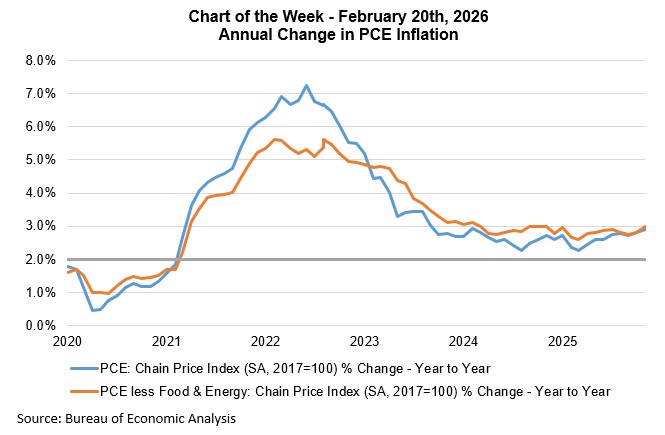
While markets were eager for Friday’s report on Q4 2025 GDP, perhaps the most significant result was that PCE inflation increased 2.8% compared to a year ago, a reacceleration from the third quarter, with the core measure exhibiting a 2.9% increase.
As seen in this week’s chart, both measures are well above the Fed’s 2% target and today’s report, along with the strong January jobs report, suggest that the likelihood of a rate cut at the next FOMC meeting might be lower.
The economy grew 2.2% in 2025, slower than 2024’s growth rate of 2.4%, consistent with weaker hiring across many industry sectors and the upward trend in unemployment. The theme of uneven growth was reflected in the data. While consumer spending was a primary driver of growth in the quarter, spending on goods declined slightly, while all the growth was concentrated in spending on services. Business fixed investment also supported the fourth quarter gain, primarily through increased investment in information processing equipment and intellectual property products. Companies are still heavily investing in technology but less so in other categories such as non-residential structures. Residential investment contracted for the fourth consecutive quarter.
We expect a similar pattern of economic growth in 2026, with a forecasted growth rate of 2.1%, as households with sufficient income and wealth continue to drive consumer spending, while pressure continues to build for other households under strain from higher costs, longer unemployment spells, and high consumer credit balances. We expect that the job market will continue to slow, with the unemployment rate reaching 4.5% in the first half of 2026 before declining over the next two years.
-Joel Kan (jkan@mba.org)
