

Christine Chandler: CRE Market Adapting to Higher-Rate Environment
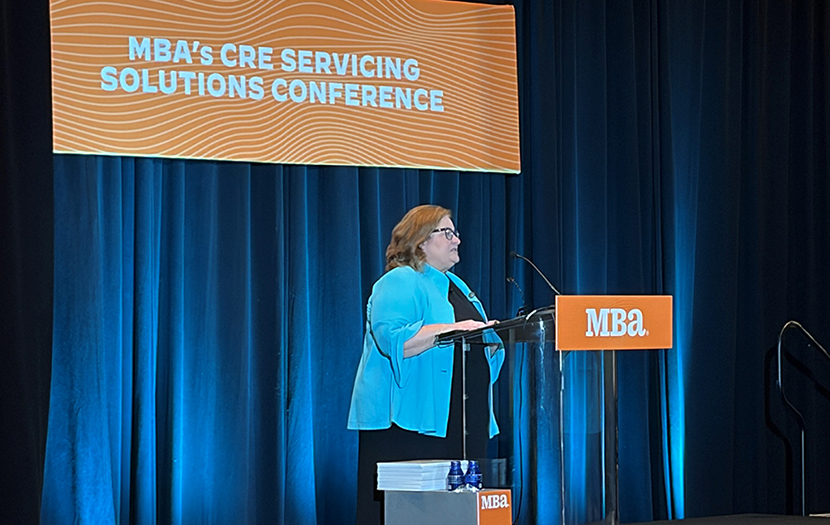
SAN DIEGO–The commercial real estate market is showing it can adapt to a higher-rate environment, and that means more opportunities for lenders and more servicing activity, MBA Chair Christine Chandler said here at MBA’S CRE Servicing Solutions Conference.
Chandler also serves as EVP, chief operating officer and chief compliance officer at M&T Realty Capital Corp. She noted that many in the audience remember the conference’s previous iteration, MBA’s Commercial/Multifamily Servicing and Technology Conference.
“And many of you attended [MBA CMST],” Chandler said. “The reasons for attending are the same–this conference offers the latest on servicing strategies and innovative solutions in a landscape that is always changing. This is your chance to learn about changes in public policy, market forces, technological developments, and industry best practices in formal presentations or informal networking with industry leaders and peers. So, we are glad you are here!”
Chandler noted commercial real estate finance has been through some challenging times in recent years, including COVID and its aftermath, a surge in inflation and interest rate hikes coupled with fears of recession and political tension and dramatic changes in policy in the last year.
“And yet, capital market conditions stabilized in 2025, and there was a meaningful rebound in commercial real estate lending activity,” she said. “Originations increased 40% from 2024 and rose sharply from the prior two years.”
“The strength in multifamily originations, increased lending from depositories, and an inflow of capital from private sources, all point to continued confidence across the commercial real estate finance market. In other words, the CRE market is showing it can adapt to a higher-rate environment. That means more opportunities for lenders and more servicing activity.”
Chandler noted a shift in regulatory policy in Washington. “There is a bias for clearing any regulatory hurdles that have acted as restraints on construction and development,” she said. “Elected officials are hearing constantly about voters’ frustration with the lack of affordable housing. This is especially acute in the rental housing sector in many markets.”
She said MBA has been working closely with officials in key government agencies as well as leaders on Capitol Hill to shape policies that will help commercial and multifamily development and lending activity to thrive.
“For example, in March, MBA’s Senior Vice President Jamie Woodwell represented the CRE industry at a public meeting concerning the Federal Reserve’s Economic Growth and Regulatory Paperwork Reduction Act. He highlighted areas where regulations are hindering depositories, including: the Community Reinvestment Act, outdated bank capital requirements, supervisory guidance pertaining to CRE lending, and other issues,” Chandler noted. “On those outdated bank capital requirements, there appears to be relief in sight. An updated proposal of the so-called Basel III endgame was issued by U.S. regulators in late March.”
A few weeks ago, MBA President and CEO Bob Broeksmit, CMB, told the House Financial Services Committee that the new version of bank capital requirements adopts many changes MBA has advocated for over many years. It better aligns capital requirements with the actual risk profile of mortgage lending and servicing. “Among the changes, this smarter approach will help increase demand and create greater liquidity for MSRs and expand access to mortgage warehouse credit lines,” Broeksmit testified.
Chandler noted that on Capitol Hill, there is near-unanimous, bipartisan agreement on legislation in both the House and Senate to spur housing construction and reduce or reform regulations that add to the cost of housing.
“This is a good sign that elected officials are tuned into voter concerns about costs and availability,” she said. “You would think it would be relatively easy to iron out differences between the House and Senate bills. Of course, as we know, enacting legislation in Washington is often a Rubik’s Cube of political factors. But last week, we inched a little closer. House Financial Services Committee Chairman French Hill and Ranking Member Maxine Waters came together to support an amended bill, which could be on the House floor this week.”
Chandler added that the compromise addresses several concerns that MBA had with a Senate-passed version of this bipartisan legislation. “For example, it fixes a drafting error in the Senate bill that would have effectively lowered FHA’s multifamily loan limits. It also softens the Senate language that would have expanded FHA’s consumer disclosure requirements to include VA loan pricing comparisons.”
MBA’s main objection was a provision in the Senate bill’s ban on housing purchases by institutional investors, Chandler said. “We believe a sweeping ban would suppress new rental home construction, leading to less supply and higher prices–not exactly what consumers need!”
The House bill clarifies and broadens the Senate bill’s exemptions to the institutional investor ban for build-to-rent properties and attached/contiguous multifamily properties, Chandler said, noting MBA still has concerns.
“MBA expressed support for the new House bill. Our hope is that the House’s adoption of a new version will give the legislation momentum and create an opportunity for us to address the institutional investor prohibition and other items in the final version of the legislation. The revisions by the House reflect months of work by MBA staff, our coalition partners, and you, our members. Our Mortgage Action Alliance members sent more than 1800 letters to their members of Congress calling for these changes. Nearly 450 MBA members from 43 states came to Washington in April for our National Advocacy Conference to lobby for these improvements.”
Chandler added that during MBA’s National Advocacy Conference in April, MBA hosted a dedicated CREF track that featured discussions with key legislators, an advocacy/networking lunch on Capitol Hill and meetings with Treasury officials.
Though progress in Washington can be frustratingly slow, developments on Capitol Hill and in Executive Branch agencies show that when MBA and its members speak with one voice, we can make a big impact for our companies and our customers, Chandler said: “Just ten days ago, MBA welcomed updates by HUD to some requirements in its Federal Housing Administration Multifamily Accelerated Processing Guide. Secretary Scott Turner and his team responded to calls from our multifamily members to streamline requirements in FHA’s multifamily lending programs. This will lower development costs and accelerate the delivery of much-needed rental housing.” “What matters is that there is momentum for action,” she added.
“MBA will work with the White House, federal housing agencies, and industry stakeholders throughout the regulatory reform process to ensure these enhancements are effective, practical, and implemented in a way that benefits consumers, lenders of all business models, and the broader housing market,” Chandler concluded.
