

New Report Finds Cooling Rental Markets, But Deepening Affordability Crisis
(Stock photos: Mike Sorohan)
Despite a recent softening in rents for new leases, rental housing remains unaffordable for many households, according to a new report by the Joint Center for Housing Studies of Harvard University.
America’s Rental Housing 2026 noted that after record rent increases during the pandemic, national rent growth hovered near zero from mid-2023 into 2025. By the fourth quarter of 2025, asking rents for professionally managed apartments declined 0.6% year over year, with the majority of large markets seeing either small declines or only modest growth. Vacancy rates ticked up to 5.2%, matching their level a year earlier as rental demand slowed faster than new supply came online.
But headline numbers showing flat or falling rents can be misleading, said Chris Herbert, managing director of the Joint Center for Housing Studies. “For millions of renters, especially those with lower and moderate incomes, housing is deeply unaffordable,” he said. “Years of rent increases and the loss of lower-cost units have left many households with no cushion and very few options.”
Robust Construction Cools as Costs Rise
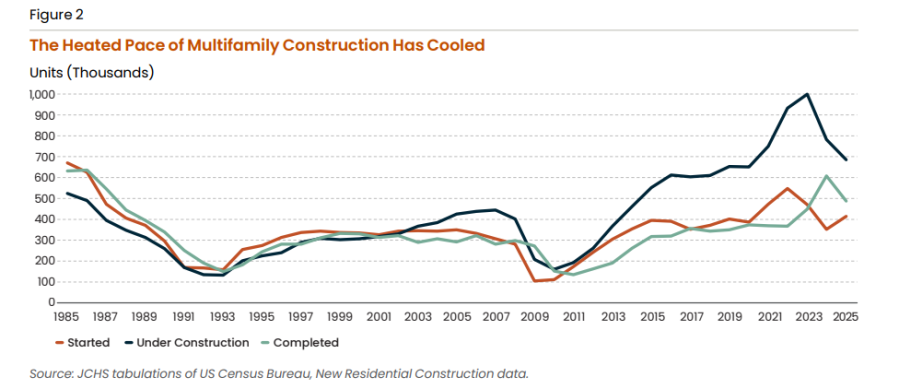
Multifamily construction remains elevated by historical standards, but has retreated from recent peaks. Developers started 416,000 multifamily units last year; well below the three-decade high reached in 2022 but still above pre-pandemic norms. At the same time, the number of apartments under construction fell sharply from a record 996,000 in 2023 to 686,000 in 2025, and the latest market data show a steep year-over-year decline in starts, signaling a broader slowdown ahead.
“Rising construction and labor costs have contributed to this pullback,” the report said. Between January 2020 and December 2025, the prices of material inputs to new residential construction rose 42%, while employment costs for construction workers climbed 24%. “These pressures have pushed new development toward higher-rent segments and contributed to an upward shift in the rent distribution. From 2014 to 2024, the number of units renting for less than $1,400 fell by 9.3 million, while the number renting for $1,400 or more increased by 11.8 million.”
Affordability Challenges Worsen
A record level of renters are cost burdened. In 2024, 22.7 million renter households spent more than 30% of their income on rent and utilities—49% of all renters. Some 12.1 million of these households were severely cost burdened, paying more than half their income for housing. Cost burdens have risen in 44 states and 88 of the 100 largest metro areas over the past five years, and are increasingly affecting middle-income renters.
“The affordability crisis is no longer confined to the lowest-income households,” said Whitney Airgood-Obrycki, a senior research associate at the JCHS. “We’re now seeing growing cost burdens among renters earning $45,000 to $75,000 and even among higher-income renters. At the same time, lower-income households are facing record levels of strain, with very little left over each month after paying for housing.”
The report highlighted policy innovations at the state and local level, including zoning reforms to reduce barriers to new supply, new revenue sources for rental assistance, expanding tenant protections and mixed-income affordable housing development models. Bipartisan federal legislation introduced in 2025 would take important steps to address affordability, supply shortages, repair needs and disaster recovery.
“Despite serious headwinds, there is a growing recognition across the political spectrum that safe, stable, affordable housing is fundamental to families’ well-being and to a strong economy,” Herbert added. “If we can build on emerging bipartisan momentum and learn from state and local innovations, we have an opportunity to make real progress on the nation’s rental housing challenges.”
