

MBA Chart of the Week: Monthly Payroll Growth
Source: Bureau of Labor Statistics
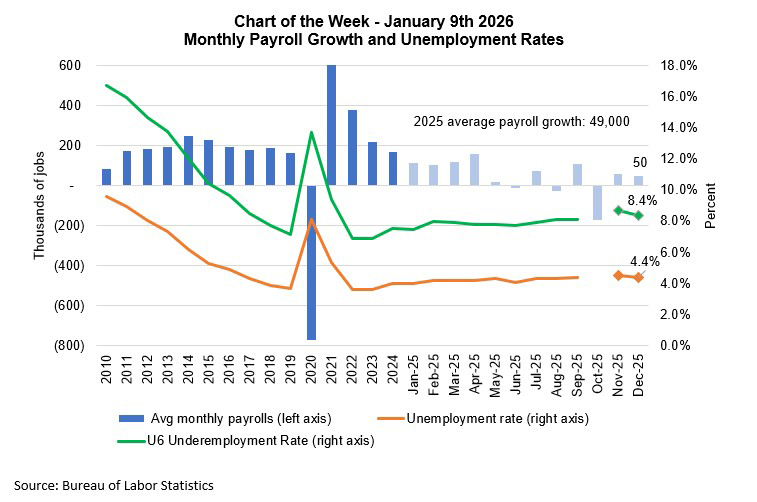
The pace of employment growth slowed in December to 50,000 jobs, in line with the average pace of 49,000 for all of 2025. Employment growth was much slower than the roughly 168,000 job pace in 2024. Employment numbers for October and November were revised downwards by 76,000, considerably weaker than initially reported.
Private sector job gains in December were concentrated in just a few sectors, including hospitality and health care. There was also an increase of 18,000 in local government jobs in December. The diffusion index, a measure of how many sectors saw job growth, was 50.8, the lowest in five months.
The economy is growing, but unevenly, and employers certainly appear to be cautious about adding additional workers, as evidenced by the still very slow hiring rate in the separately released JOLTS data. Workers are also voluntarily leaving jobs at a slow pace, due to declining job prospects elsewhere.
The unemployment rate declined to 4.4% in December, with the November rate revised down to 4.5% due to the annual revisions to the seasonal adjustment factors. The U6 underemployment rate declined to 8.4% but remains elevated. The participation rate dropped a tenth over the month as more individuals left the labor force. The share of workers who had been unemployed for more than six months increased to 26% in December, another sign that it is getting tougher for job seekers to find a new position.
This report is fairly neutral with respect to its implications for the housing and mortgage markets. It reinforces the sense that the economy is slowly growing but does not increase the urgency for additional rate cuts from the Fed. As we look ahead to the spring housing market, these trends are likely to support only modest improvement in the pace of home purchase activity.
– Mike Fratantoni (mfratantoni@mba.org), Joel Kan (jkan@mba.org)
