

How IMBs Can Retain Customers; Protect Margins
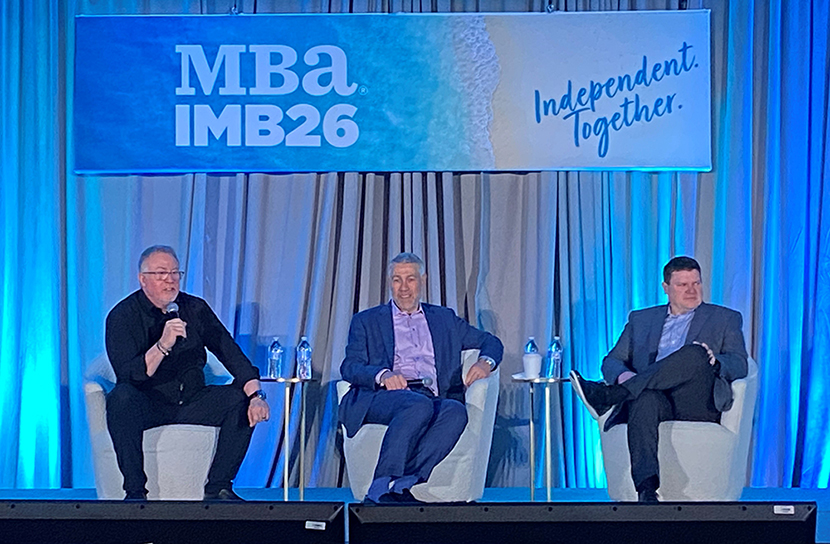
(l. to r.: Dave Savage, Christopher Mayer, Michael Patterson)
AMELIA ISLAND, Fla.–How can IMBs retain customers and become more profitable? Senior executives from Freedom Mortgage Corp. and Longbridge Financial addressed those questions here at the Mortgage Bankers Association’s Independent Mortgage Bankers conference.
Dave Savage, founder of Mortgage Coach and Chief Growth Officer of TrustEngine, interviewed Christopher Mayer, CEO of Longbridge Financial, Paramus, N.J., and Michael Patterson, senior executive vice president and COO of Freedom Mortgage Corp., West Palm Beach, Fla., about how they are reimagining borrower engagement, strengthening post-close relationships and delivering experiences that drive repeat business.
Savage noted that he recently hosted MBA 2026 Chair-Elect Owen Lee, CEO of Success Mortgage Partners, Plymouth, Mich., on his podcast. In that interview, Lee discussed how smart IMBs use technology, data and leadership to increase loan volume and profitability.
“For us, at our core, we say ‘customer for life’,” Patterson said. “When we get a customer at Freedom, we have a very intense goal to keep that customer. I think that’s different than some of our peers in the industry. We’re a privately held company, so we look at the asset a little bit differently. We look at it and ask, how do we keep that borrower? While some of our peers may look at keeping the asset value, AKA a hedge, we concentrate everything around how we keep that customer.”
Patterson said one important piece of keeping a customer for life is meeting the customer where they want to be met. “Not meeting them where we want them to meet us. So sometimes that can create a little bit of inefficiency; sometimes that means doing things a little bit differently than you might in a perfect world,” he said. “But if I ask everyone in this room how they want to be met with your mortgage, some are going to say chat, some will say text, some will say email. Some people are going to want to talk on a phone call. Some are going to say, ‘I’m okay talking to somebody offshore;’ others are going to say, ‘I want to talk to people on shore.’ So, you have to be a little bit of a chameleon, but still be operationally efficient. And measure it.”
“That’s one of our core messages,” Patterson added. “Meet the customer where they want to be met.”
Christopher Mayer, CEO of reverse mortgage lender and servicer Longbridge Financial, agreed that customers differ from each other, “so how we work with them ought to be different for different customers. I think asking the question of ‘how do you think about working with customers’ as opposed to ‘how do you apply technology’ is an important way of thinking about this.”
Mayer noted that, as a reverse lender, the goal is that, eventually, every one of the firm’s customers will die while still having a relationship with the firm.
“And so we think very much about servicing from the point in time that the customer comes in the door, all the way through to what happens in working with heirs if the customer has been successful,” Mayer continued.
Nearly everyone would prefer to pass in their home with family and friends and loved ones around, Mayer said. “So, how do we help that customer through that process? How do we help them use home equity to deal with financial problems through the time period when they were thinking about retirement, all the way through the time period that the retirement is going to come to an end. And that happens with servicing. It happens with relationships.”
Mayer noted Longbridge has a team of people that specializes in working with people during different parts in the process, “from working with heirs who want to sell the home to working with people whose parents just moved to assisted living. They ask, ‘what are we going to do?’ And we’ll help them through the various stages of the process.”
That work is all done onshore with people based in the U.S., Mayer added. “But we also just rolled out an AI bot for servicing for our customers–not through the sub-servicer–that is going to do basic stuff to help people do what they want to do in the interim. So for us, that idea of customer life and how you work with somebody is incredibly important.”
“I’ll say one other thing. I think a lot of people, when they think about retaining customers, if they don’t have products designed for people who are in the later stages of life are really missing a tremendous opportunity,” Mayer concluded. “We know that one-third of all homes are owned by people 65 and older and that’s growing by a few tenths of a percent every year and is likely to continue to grow. The home ownership rate for people age 65 and above is north of 78%, so there are a lot of people. So having products designed for people at that stage in their life cycle is important.”
