

Are Data Centers a Bubble? What About AI?
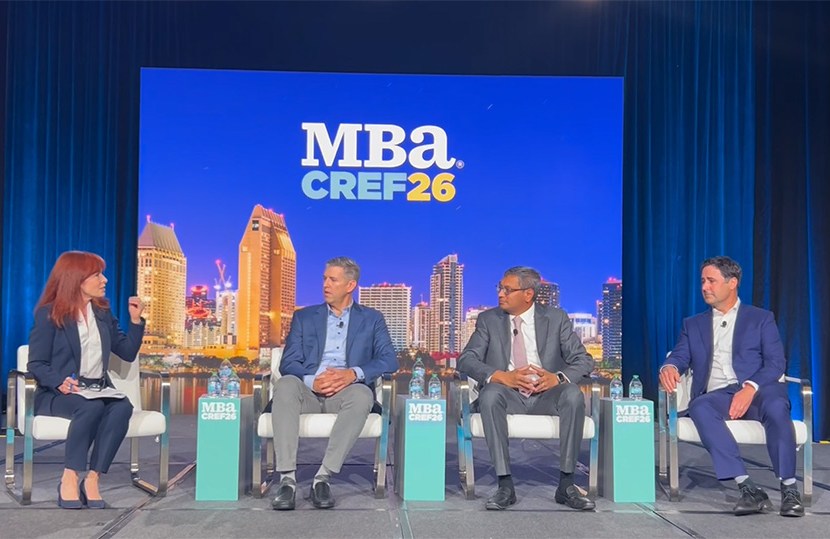
(From left: Diana Olick, Matt Mercier, Ankit Patel and Chad Phillips. Photo by Anneliese Mahoney)
SAN DIEGO–Those were questions that multiple panelists attempted to parse Feb. 10 at the Mortgage Bankers Association Commercial/Multifamily Finance Convention and Expo.
While moderating a panel on institutional investors, CNBC’s Diana Olick asked the former question of Matt Mercier, chief financial officer at Digital Realty, which operates more than 300 data centers across 50 markets globally.
Mercier pointed out that while data centers are hot right now, he’s been working in the space for nearly two decades, back when they were far from the spotlight.
“We’ve been on a growth path for that entire time,” he said. “It feels like every four to five years, there’s something that comes along that initially everybody thinks is going to kill data centers. That actually is what propels our next leg of growth.”
In terms of a global outlook, Mercier pointed out that while his firm is seeing significant investment in the U.S., there’s global interest as well, ranging from Europe to APAC. “Those builds are not as large as what we’re doing in the U.S. today, but they are growing,” he said. Capital is “generally abundant” for data centers in the U.S. and overseas, he noted.
Chad Phillips, global head of real estate at Nuveen Real Estate, said data centers make up a few billion of the firm’s broader portfolio.
“But my view is really shorter term. It’s really hard to predict where the market’s going to be in 10 years,” Phillips said. “However, you can’t ignore the demand that’s there today. So when we play in data centers alongside our infrastructure team, it’s really going to be in new builds where the power is already there and where we think we can exit within three to seven years, sometimes quicker.”
Another panel, focused on CRE Executive Perspectives and moderated by Walker & Dunlop Chairman and CEO Willy Walker, also tackled the potential bubble–or lack thereof–with data centers.
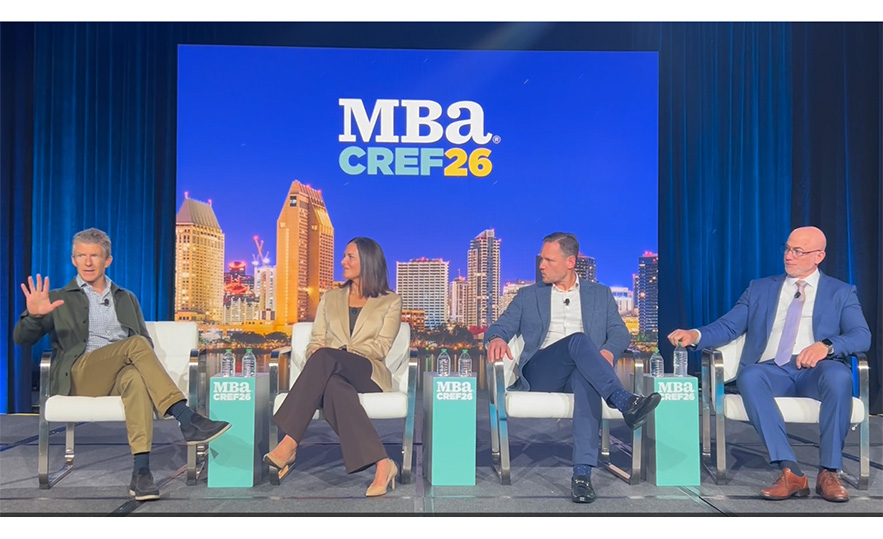
“Do you have any concerns that we are overbuilding, that we are in a dot com bubble as it relates to the amount of capital that’s going out to data centers right now?” Walker asked Michelle Herrick, head of commercial real estate for J.P. Morgan.
“We feel comfortable with what we’ve done so far,” Herrick said, noting that like with any sector, fundamentals, exposures and other details matter. “Remember, a lot on the balance sheets is the construction, so a shorter-term hold period into what will ultimately have to be graded, which is a broader, long-term market of significant size for these assets.”
James Millon, president and co-head of capital markets for the U.S. and Canada at CBRE, said that his firm has invested in an information advantage. “We have data center specialists, we have the operational side of the business. We’ve made principal investments in the sector through our real estate investing segment,” he said. “We bring all that together to inform our views as to what is the right risk-adjusted returns for that sector.”
Herrick also pointed out that there are broader geopolitical issues at play in discussions around data centers. “You want the U.S. to dominate this space. It’s essentially using everyone’s data, and so it’s also a security risk and an investment thesis for our country to make sure that we’re doing quite well in this space,” she said.
Data centers go hand in hand with one of the other most popular technology trends–AI.
Phillips noted that Nuveen has both broader AI across its platform and bespoke AI for specialized uses. “I’m sure you’ve heard the term ‘human in the loop,’ ” he said, pointing out that AI is sometimes wrong and needs a human element to step in.
“We’re very, very interested to see how we can be more efficient,” said Ankit Patel, executive vice president and chief financial officer at BioMed Realty. He said AI is part of that discussion, but the risk of error remains an issue. He pointed to smaller applications like chatbots that help with policies as good current use.
A top concern when it comes to AI use is the impact it will have on jobs. On the executive perspectives panel, Justin Wheeler, CEO of Berkadia, said he doesn’t know exactly what the job landscape will look like by say, 2030, because “technology is changing so fast.”
Wheeler described the “science” in the business–essentially repetitive, process-based tasks. “And then there’s the art. And people are the art, and machines are the science, and we want all the science to be done by machines, because that frees up the creative spirit of the Berkadians to solve people’s problems, to engage with their clients more, to understand deeper what the issues are.”
