

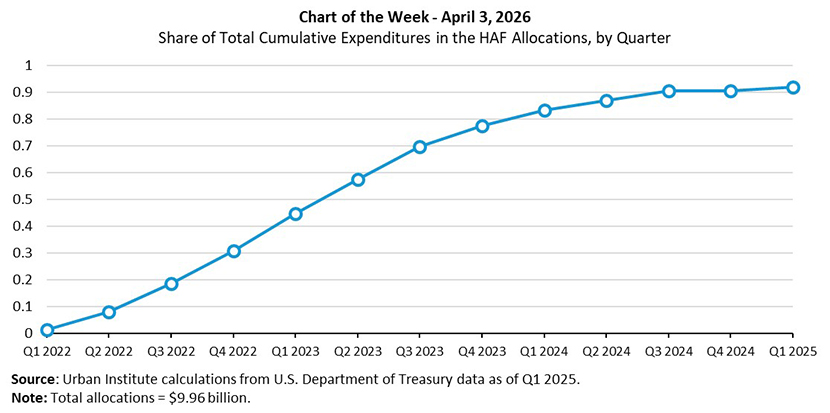
Chart of the Week: Share of Total Cumulative Expenditures in the HAF Allocations
Last week, the Research Institute for Housing America (RIHA), MBA’s think tank, released a special report, Stabilizing Vulnerable Homeowners in a Time of Crisis: Insights from the Homeowner Assistance Fund. The report examines the Homeowner Assistance Fund (HAF), a $10 billion federal program launched by the U.S. Department of Treasury in April 2021 to help vulnerable homeowners recover from financial hardships related to the COVID‑19 pandemic.
While pandemic‑era mortgage forbearance policies have received significant attention—and are now a permanent part of the loss‑mitigation waterfall for homeowners with federally backed mortgages—the HAF program has been less well understood. According to Professor Stephanie Moulton, the report’s lead author, the RIHA study “is the first to examine the $10 billion HAF program and the homeowners who benefited. The insights from this report help us better understand potential gaps in the loss‑mitigation waterfall and the types of homeowners who may benefit from targeted support when they experience a crisis.”
This week’s MBA Chart of the Week replicates Figure 3.0.1 from the report and shows that HAF expenditures increased consistently quarter over quarter from Q1 2022 through Q3 2023. The program was heavily subscribed: states and tribes had spent 77.5 percent of their allocations by the end of 2023 and more than 92 percent as of Q1 2025.
To assess the effectiveness of these targeted assistance funds, the report provides a detailed analysis of how HAF assistance was distributed and used nationwide, highlights differences in state implementation, and examines the characteristics of borrowers who received support—many of whom required assistance beyond traditional forbearance and loss‑mitigation options.
In addition, using detailed data from the state of Ohio, the report compares the characteristics of homeowners who received mortgage payment forbearance during the COVID‑19 pandemic with those who received assistance through HAF, either in addition to or instead of forbearance.
As noted in Tuesday’s press release, “The research highlights not only the success of broad‑based relief efforts like forbearance, but also the critical role of targeted programs such as the Homeowner Assistance Fund in supporting more vulnerable borrowers. As we look ahead, these findings offer important lessons for how policymakers and industry stakeholders can respond to future economic disruptions while promoting sustainable homeownership.”
