

MBA Chart of the Week: Consumer Price Index Inflation
Source: Bureau of Labor Statistics
The impact of the war in Iran and the disruption of shipping routes through the Strait of Hormuz has pushed inflation to the forefront of economic concerns. The most immediate effect has been on crude oil futures, which have gone from around $65 a barrel before the war to as high as $120, with dramatic weekly swings as the geopolitical situation remains fluid. Higher fuel prices will raise transportation and travel costs, ultimately affecting the prices of goods and services globally.
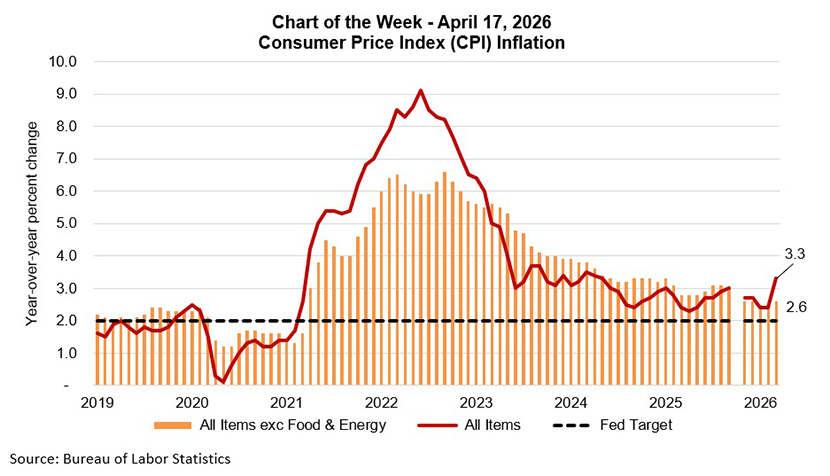
In the U.S., annual inflation, as measured by the Consumer Price Index (CPI) jumped from 2.4% in February to 3.3% in March. The increase was largely driven by fuel related categories – motor fuel inflation accelerated to 19.2% annual growth after experiencing almost three years of annual price declines and airline fare price growth surged to 14.9% in March from 7.1% in February.
While other major categories of inflation showed relative stability in March, the effect of significantly reduced shipping traffic in the Strait will show up in the coming months, and there is still great uncertainty about how long the current conflict will continue. The longer the war and disruption to oil production and shipping continue, the larger the negative impact on the global economy. US goods prices, excluding food and energy, were up 1.2 percent, in line with recent months. However, overall goods prices will likely rise in the coming months given higher costs and lower availability of key inputs such as fertilizer, helium, and LNG, a large share of which is shipped through the Strait.
Shelter costs, which carry the largest weight in the CPI, remained on a slow downward path, while rent and owners’ equivalent rent grew by2.6% and 3.1%, respectively. Market rents in the US continue to slow, along with cooling home price growth in many local markets.
As the conflict with Iran continues, we reduced our forecast for US economic growth in 2026 to around 1.5%, as consumers pull back on spending amid higher prices and businesses remain cautious. For 2026, we expect roughly 4% annual growth in CPI inflation.
The higher inflation forecast also means that Treasury yields and mortgage rates may stay higher for longer, with mortgage rates closer to 6.5% in 2026. Please look for our April forecast release over the coming week for the full set of details.
