

Chart of the Week: Potential Trajectories of Multifamily Completions
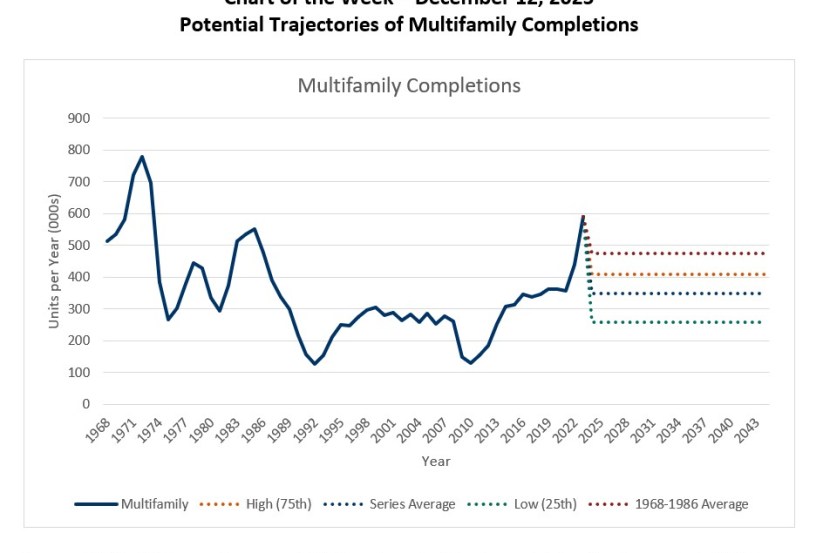
Developers have been building many apartment units over the past several years. We expect the pace of development to slow in the years ahead, given declining fundamentals including falling rents, rising vacancies, and increasing delinquencies in the multifamily sector (see MBA CREF Databook).
This Chart of the Week focuses on trends in multifamily completions over time. The solid line represents the historical series from 1968-2024. The dotted lines show MBA’s estimates of future completions assuming the historic average (348k per year, blue), the 25th percentile (259k per year, teal), the 75th percentile (409k per year, orange), and the 1968-1985 average (474k per year, red).
The figure shows that 2024 completions (589k per year) were well above the historic average and the 75th percentile of the historic series. In fact, 2024 completions were the second highest ever reported in the series. The peak of completion was in 1972 (779k units per year). The 2024 completions also sit above the average over the 1968-1985 housing boom. This follows a period earlier this decade when more than 1 million multifamily units were under construction. Trends in multifamily starts and units under construction lead trends in completions by a few years.
We expect multifamily starts and completions to come down. The 1970s and 1980s housing boom was driven by a significant increase in the demand for housing due to the coming of age of the baby boomers, which generated price signals sufficient to spur the development of new housing. In contrast, apartment rents and multifamily values have fallen, and vacancies have increased over the last few years. This suggests a softening of future starts, construction, and completions.
MBA Research forecasts growth in multifamily originations in 2026 and 2027, driven by maturing loans needing to refinance and new acquisitions.
– Judith Ricks, Ph.D. (jricks@mba.org)
