

Broeksmit Testifies at Congressional Subcommittee Hearing
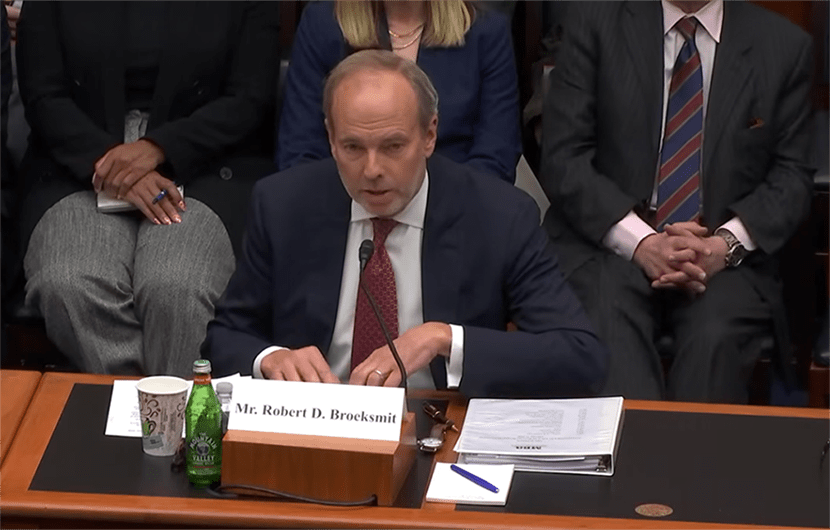
(Image: Video capture from subcommittee hearing)
MBA President and CEO Bob Broeksmit, CMB, testified Wednesday afternoon before the House Financial Services Subcommittee on Housing and Insurance. He spoke at a hearing titled Homeownership and the Role of the Secondary Mortgage Market.
In his written testimony, Broeksmit noted the U.S. secondary mortgage market is a complex financial ecosystem where both single-family and multifamily loans – and assets such as mortgage servicing rights – are bought and sold. “Most of newly originated mortgages are sold by lenders (e.g., depositories, non-banks, and other capital sources) into the secondary market, where they are packaged into mortgage-backed securities and sold to investors such as pension funds and insurance companies, among others,” he said.
Several types of participants utilize the U.S. secondary mortgage market, including mortgage lenders and brokers, mortgage aggregators, the government-sponsored enterprises Fannie Mae and Freddie Mac, the Government National Mortgage Association, the Veterans’ Home Loan program and the U.S. Department of Agriculture’s Rural Housing Service, securities dealers/brokers and both domestic and foreign investors generate income.
“The secondary mortgage market is extremely broad and helps to make credit widely available to borrowers in all geographic locations by freeing up capital that can be utilized to issue new mortgages. This process increases liquidity and supports homeownership (and rental activity) by making financing more accessible and affordable,” Broeksmit noted.
Other players include entities that issue private-label securities (PLS), i.e., MBS created from pools of non-government-guaranteed mortgage loans that offer both investment opportunities and associated risks. “As a point of emphasis, PLS are financial instruments that are not backed by a government guarantee (either “explicit” or“implicit”),” Broeksmit explained. “Instead, they are created by private entities and typically consist of mortgages that may vary from the GSEs’ specific underwriting standards, which means investors may realize higher yields but bear more credit risk. These loans are typically pooled together in a trust, which then issues securities to investors. The cash flows from the underlying mortgages are passed through to the investors.”
Broeksmit said the U.S. residential real estate and mortgage markets play an “outsized role” in both the domestic and global economies, including $48 trillion in owner-occupied real estate value and almost $14 trillion in mortgage debt (ergo $34 trillion in home equity). “There is another $2.2 trillion in multifamily mortgage debt outstanding plus associated equity,” he said.
MBA forecasts annual mortgage origination volume of $2.2 trillion in residential home lending and almost $400 billion in multifamily lending, Broeksmit added.
The secondary mortgage market has several key principles, Broeksmit said. “The American mortgage market is unique in the degree to which 30-year, fixed-rate, fully amortizing mortgage loans (with no penalty for refinancing the loan) play such a large role in financing home purchases. This system protects borrowers against increases in interest rates while providing a long period over which to amortize the loan principal, thus providing more affordable monthly payments than would be available under a shorter amortization schedule.”
“To date, that fixed market has been supported by securitization, and both the “implicit” and “explicit” support the federal government (via taxpayers) has given that market. Securitization in the mortgage market was developed as a means of removing interest rate risk from depository balance sheets, while providing a long-term fixed-rate asset for investors that had a better capacity to manage the market risk that arises from rate volatility. This process relies on the steady presence of private investors willing to take on the risks of MBS.
Key principles that support the resilience of the secondary mortgage market include:
• Promoting liquidity and stability by connecting global capital to the U.S. mortgage market;
• Providing for a consistent offering of core products – including the 30-year, fixed rate, prepayable mortgage;
•Providing certainty in mortgage transactions for investors and qualified borrowers;
• Providing an efficient means of hedging interest rate risk through a robust To Be Announced (TBA) market;
• Relying on a single, uniform, highly liquid security;
• Ensuring that private capital assumes significant amounts of the credit risk;
• Ensuring equitable, transparent, and direct access to secondary/GSE market programs to lenders of all sizes and business models; and,
• Preserving existing multifamily executions.
“While the GSEs are a sizable and very important component of the secondary mortgage market, equal consideration and importance should be given to the impact that any potential changes to the GSEs could have on the PLS market, bank portfolio lending, and the government-backed, Ginnie-securitized programs,” Broeksmit said.
The PLS Market
“A strong secondary mortgage market should ensure the fully private, non-agency market is as robust as possible. The disappearance of the private securitization market for single-family mortgages following the Great Financial Crisis did not immediately reverse its course as the housing market recovered. In the past two years, PLS issuance has shown healthy increases, although it continues to represent only a small portion of secondary market activity,” Broeksmit testified.
“To increase secondary market competition and reduce reliance on taxpayer support, the structural impediments preventing a revival of the PLS market must be removed.”
“Since the GFC, there have been very few public PLS issuances, with most deals being private placements. To reach the broader market, MBA believes the Securities and Exchange Commission should proceed with its plan to revise the PLS disclosure framework, Reg AB II, to bring back SEC-registered PLS, which will deepen the pool of investors able to support the U.S. mortgage market.”
“These changes should also include the standardization of both data and disclosure requirements and compliance with the Dodd-Frank Act’s Qualified Residential Mortgage definition.”
“Taking these steps could help revive the PLS market and increase the diversity of viable housing finance capital sources, making the overall system more resilient – while promoting greater liquidity, lowering costs, and improving choices for borrowers.”
Bank Lending
Broeksmit said MBA appreciates the time and attention the full Financial Services Committee and its members have paid to the calibration of bank capital rules and how the broader economy is impacted – including consumer mortgage credit.
“Banks play a critical role in the US mortgage market, as lenders and servicers directly for consumers, and as liquidity providers to the non-bank/independent mortgage banks (IMBs) that today originate and service most home loans,” he said.
“In recent years, bank originations of single-family mortgages and holdings of MSRs have declined sharply due to capital rules that have made mortgages unattractive to hold and service. For several years, MBA has urged banking regulators to reform the U.S. capital framework to support more robust bank participation in both single-family and commercial real estate financing.
As the banking regulators (i.e., the Fed, FDIC, and OCC) contemplate a rewrite of the Basel III Endgame proposal, Broeksmit called it important that the following considerations be addressed:
• Reducing the 250% risk weight for Mortgage Servicing Agreements (MSAs): The current 250% risk weight assigned to MSAs has played a key role in banks’ retreat from the mortgage origination and servicing market, reducing competition for consumers and removing a bank bid for MSAs that has resulted in reduced liquidity and higher mortgage rates. To ensure that the U.S. capital framework does not continue to drive banks out of the mortgage servicing industry, which would result in a further shrinking of the mortgage servicing relationships banks have with their borrowers and communities, MBA strongly recommends that this punitive and unjustified risk weight be reduced to no more than 100%.
• Raising the Common Equity Tier 1 (CET1) cap on MSAs: The current capital framework also prescribes an unwarranted 25% cap on MSAs that can be included in CET1 capital. The dollar-for-dollar capital charge above the 25% cap forces banks that maintain large mortgage operations to incur extraordinarily punitive capital charges or sell off MSAs, thereby eliminating valuable customer relationships. MBA recommends that the cap be increased to 50%. A 50% cap would ensure banks that view the mortgage market as a core strategy, and not just a product, can continue to hold MSAs and maintain the vital customer relationships that play a significant role in strengthening ties with the communities they serve. Banks operating under the Community Bank Leverage Ratio should be exempt from the cap entirely. A stronger bank bid for MSAs helps ensure a more orderly and liquid MSA market for all participants — both banks and nonbanks — and contributes to overall financial stability in the single-family mortgage market.
• Reducing the 100% risk weight on warehouse lines of credit: The current capital framework assigns a 100% risk weight to warehouse lines of credit. Bank warehouse lines are a critical source of support for the U.S. mortgage market, providing funding to companies that originate more than 60% of single-family mortgages. When capital requirements are set too high, warehouse lenders are unable to supply the necessary liquidity to meet spikes in demand, thereby increasing the cost of lending to all borrower segments. Given the short duration of warehouse credit exposures and the banks’ ability to take possession of the underlying collateral if needed, the capital treatment of residential mortgage loans held on a warehouse line should be reduced and assigned the same risk weight as the mortgages collateralizing the warehouse line.
FHA and the Conventional GSE Market
Government-insured FHA and RHS loans play a critical role in serving low- and moderate-income families, particularly first-time buyers, Broeksmit said. “FHA and RHS loans help borrowers with limited resources for downpayments and less than pristine credit qualify for home purchase financing. For example, nearly 85% of FHA borrowers in recent years were first time buyers. Both FHA and RHS have lower median incomes, lower median credit scores, and higher loan-to-value ratios than conventional loans sold to the GSEs.”
“The conventional and government insured markets do, however, have overlapping borrower demographics, and changes in underwriting requirements or insurance premiums and guarantee fees in either program can shift market shares and subject programs to new risks if these changes are not well coordinated. For example, if the GSEs reduce pricing on their targeted programs for LMI borrowers, that tends to capture some of the higher quality business that FHA would normally get, exposing FHA to adverse selection. Conversely, if FHA lowers its mortgage insurance premiums (MIP) and the GSEs do not reduce Loan Level Price Adjustments (LLPAs), FHA will capture share from the GSEs, moving taxpayer risk from the implied guarantee of the GSEs to the full faith and credit of the FHA.”
“In keeping with the desire for holistic reform, MBA urges policymakers to consider the implications of any policy changes in one mortgage market segment on the other key segments. Coordinated policy moves – for example, a coordinated reduction in the FHA single-family MIP with a reduction in the GSEs’ LLPAs, can mitigate adverse selection risks and taxpayer exposures.”
Innovation versus the Sanctity of Existing Contracts
“Another key principle MBA supports strongly is upholding the sanctity of existing contracts,” Broeksmit said. “Several innovative ideas have been ‘floated’ recently, such as adding loan provisions retroactively to enable homeowners to take low-rate mortgages with them to a new property (i.e., mortgage portability) or subsidizing (in some manner) the costs of giving up those low rates through “defeasance” or other features.”
“For both legal and economic reasons, applying these concepts to existing mortgages would pose a significant threat to market stability. Mortgage investors have purchased MBS based on certain investment expectations, disclosed loan terms, and contractual provisions in the notes and deeds of trust. Retroactive portability would violate the “due-on-sale” clauses included within most individual mortgage notes. Portability would damage those investment expectations and change the terms of the disclosed and agreed upon securities, radically altering financial assumptions, performance and investor economics.”
“It would be dangerous to assume that such a significant change with respect to the structure of existing securitized loans could be made without significant harm to investors and substantial disruption to their willingness to buy newly issued MBS.”
“Applied prospectively to new mortgages, it not clear that portability would improve affordability as investors would likely pay less for loans with this feature. While there is certainly room to launch pilot programs to test these alternative loan features to see whether there would be borrower and investor demand for such changes, MBA does not see any path to making these types of changes on existing loans to address the housing inventory “lock-in” effect today without harming the potential of future borrowers to access market liquidity.
Housing GSE Policy
“As mentioned previously, the GSEs’ role within the secondary market is substantial,” Broeksmit said. “They stand behind nearly $8 trillion in outstanding conventional mortgages, support the deep and liquid TBA market that enables lenders to lock rates at application, make the 30- year fixed-rate prepayable mortgage broadly available, and provide reliable capital for multifamily housing in all market cycles.”
“All current mortgage market participants have a stake in addressing the last piece of unfinished business from the 2008 financial crisis: sustaining a housing finance system that can serve the interests of homeowners and renters now and for many years to come. Though not the primary subject of today’s hearing, MBA welcomes the opportunity to work with the Trump administration and Congress should a serious attempt be made to end the conservatorship of the housing GSEs, which was never intended to be permanent.”
“Such an exit, when attempted, must be executed carefully, with an ample runway to ensure deep, liquid secondary markets for single-family and multifamily mortgages through all economic cycles and in all geographic regions.”
“Regulators should continue to support the ongoing gradual restoration of capital at the GSEs. Accordingly, MBA has once again convened a blue-ribbon task force of industry practitioners (representing both the multifamily and single-family sectors) to delve into the complex set of issues surrounding the secondary market to help frame the practical implications of any material changes affecting the housing GSEs.”
“Given their critical role in the housing finance market and the economy, choosing how to end conservatorship — without major market disruptions – matters. MBA’s core principles for such an exit include:
• Preserving competition between at least two GSEs.
• Maintaining strong capital aligned with bank capital requirements for mortgage exposures, with appropriate recognition of credit risk transfer (e.g., mortgage insurance, CRT).
• Enhanced responsibilities for FHFA that require the regulator to:
Maintain a level and transparent playing field with respect to all components of pricing, underwriting requirements, and credit variances without regard to the volume, business model or delivery channel of single-family lenders.
• Ensure the GSEs do not engage in primary market origination and servicing functions.
• Maintaining alignment between the GSEs on certain issues, most notably in preserving the UMBS – one of the most important post-crisis GSE developments.
• Preserving existing multifamily programs.
“Finally, most critical in any release/reprivatization discussion, the GSEs should have a well-defined federal backstop that clearly articulates when it can be invoked, what its limits are, and who/what the backstop covers. The backstop should:
• Be applied to GSE MBS only,
• Cover tail risk only (after extinguishing PMI, CRT, and GSE reserves and capital),
• Be paid for by the GSEs.
“This well-defined federal guarantee is essential for maintaining stability and liquidity in the secondary market, as such a backstop undergirds global investors’ confidence in holding and selling mortgage-backed securities, which in turn enables homebuyers to access credit even as market conditions and interest rates fluctuate,” Broeksmit said.
Housing Affordability
The mortgage markets (both primary and secondary) are increasingly governed by overlapping, highly complex regulations that have negatively impacted costs, making it significantly more expensive to originate and service a mortgage – and for Americans to purchase or rent a home, Broeksmit said.
“We share this Subcommittee’s (and full Committee’s) view that comprehensive legislation, such as H.R. 6644, the bipartisan Housing for the 21st Century Act, is necessary to help address the nation’s housing affordability challenges – problems that demand the focused attention of Congress and the federal agencies that regulate key aspects of the housing ecosystem. Both legislative and regulatory reforms are needed to appropriately improve affordability and address the nation’s housing supply shortage.”
“Accordingly, MBA strongly supports the bipartisan consensus you achieved within H.R. 6644 on issues including: streamlining and modernizing regulatory reviews, improving access to FHA small dollar mortgages, increasing FHA’s multifamily loan limits to more accurately reflect construction costs, improving key elements of the Rural Housing Service program, increasing interagency coordination on housing policy at HUD, the VA, and USDA, and enhancing congressional oversight of all federal housing programs.”
“MBA also believes there are several near-term administrative actions that can be taken immediately to directly lower costs for home mortgage borrowers, including:
• Ending the tri-merge credit reporting requirement and allowing for a singlefile framework (FHFA/GSEs).
“The GSEs should eliminate the requirement for a tri-merge on every loan and adopt an alternative credit reporting framework that gives lenders the flexibility to order only one report. A single-file framework promotes beneficial competition in the credit reporting space, encourages innovation, streamlines origination processes, and reduces borrower and lender costs that have seen dramatic increases in recent years.
• Responsibly reducing mortgage insurance premiums (HUD/FHA). FHA’s recent actuarial report on its single-family Mutual Mortgage Insurance Fund shows a reserve ratio of nearly 11.5%, which is almost 6 times the statutory minimum. The Administration should consider lowering the annual single-family MIP – and/or eliminating the life-of-loan premium – to provide immediate financial relief to borrowers and expand access to homeownership. Importantly, any MIP cut should be carefully coordinated with program and underwriting adjustments to address risk-layering factors and mitigate rising delinquency rates.
• Coordinating reduced Loan Level Price Adjustments (LLPA) across the grid and eliminating LLPAs for rate/term refinances (FHFA/GSEs). Absent adjustments to LLPAs, a lower MIP will only shift market share from the GSEs to FHA. This necessitates a coordinated reduction in the GSEs’ LLPAs. The GSEs should implement a simple, targeted approach by modestly lowering LLPAs across-the-grid for purchase loans and removing all LLPAs for rate/term refinances where the borrower has an existing GSE loan and a strong payment history (i.e., no late payments in the last 12 or 18 months).
Multifamily
“Again, though not the focus of today’s hearing, MBA’s views on the multifamily housing finance market run parallel and are consistent with our expressed views on the single-family residential market,” Broeksmit said. “More than one-third of American households rent their home, and more than twenty-two million of those households live in multifamily rental housing, defined as a development with five or more units.”
“Recognizing the unique attributes of the multifamily market as a key component of the broader housing continuum, MBA believes that policymakers should adhere to certain key principles in preserving the government’s role regarding multifamily housing finance, as follows:
• Our nation’s housing policies should continue to reflect the importance of multifamily rental housing, various capital sources that support this market, and the need for liquidity and stability in all market cycles.
• While the roles of the GSEs and FHA in financing multifamily mortgages have been substantial, a broad range of capital sources – including life insurance companies, banks, and other lenders – have maintained a strong presence as well.
• The role of private capital has been vital to multifamily housing in several respects, including the deployment of private capital through portfolio lenders and CMBS investors and the private capital embedded within existing market executions through risk-sharing structures (e.g., Fannie Mae DUS and Freddie Mac K-deals).
• The GSEs and FHA have continued to serve a consistent, stabilizing role that provided liquidity during economic cycles when private capital sources were compelled to exit the market.
To conclude, Broeksmit noted again that he appreciates the opportunity on behalf of the MBA to comment on the many complex components of our nation’s secondary mortgage market system, as well as the related policies under discussion that may impact the health of this critical portion of our country’s housing ecosystem and macroeconomy.
“Our association and its members look forward to continuing to work with the Trump administration (e.g., the White House, Treasury, HUD, FHFA, and other agencies) and members of this Subcommittee (and the full Committee) to serve as a resource while important discussions regarding housing – and our nation’s secondary mortgage market – continue,” he said.
