

ROAD to Housing Fixes, Credit Reporting Among MBA Advocacy Priorities, Broeksmit Says
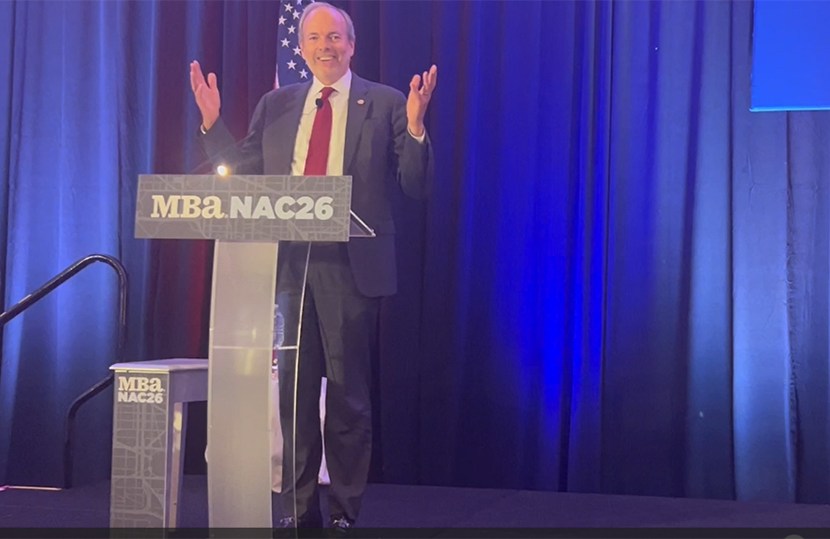
(Bob Broeskmit, by Anneliese Mahoney)
WASHINGTON–The Mortgage Bankers Association has remained focused on policy wins over the past year and is making progress on many more goals, said MBA President and CEO Bob Broeksmit, CMB.
For one, MBA has a series of concerns about the Senate’s 21st Century ROAD to Housing Package. Taken as a whole, it “has the potential to meaningfully improve housing supply and affordability,” Broeksmit said. But issues include a drafting error related to FHA multifamily loan limits, a single-family housing investor ban, costly FHA disclosure changes and a proposal to divert funds from the FHA Mutual Mortgage Insurance Fund to support foreclosure counseling for FHA, VA and USDA loans.
MBA is urging the House to negotiate improvements to the Senate bill or call for a conference, Broeksmit explained.
The organization continues to push for modernization of credit scoring and reporting as well.
“Tri-merge has become a license for monopoly pricing–and consumers ultimately pay the price,” Broeksmit said. “Our goal is to fix the underlying problem–which is lack of competition–in a safe, data-driven manner with appropriate business rules to guard against adverse selection.”
MBA continues to be engaged on the new proposal related to capital requirements released last month.
In terms of capital reforms, MBA is pushing to reduce capital charges for lower LTV loans held on bank’s balance sheets, giving appropriate capital relief for private mortgage insurance, improving capital treatment of retained MSRs and expanding access to warehouse lines of credit.
Concerns about affordability continue to be front and center, and MBA has remained engaged there, too, sending a letter earlier this year to National Economic Council Director Kevin Hassett offering a series of suggestions to improve affordability.
“We support efforts to reform appraisals, ease construction regulations and encourage homebuilding to address the structural challenges driving up housing costs,” Broeksmit said. “The overarching goal should be to revise overly burdensome rules for lenders of all sizes and business models, including credit unions and IMBs, so that all borrowers benefit.”
And, MBA continues to monitor action related to the GSEs–the administration currently appears to see advantages in keeping them in conservatorship, Broeksmit said.
“We are reassured that the administration remains opposed to actions that would raise long‑term interest rates or undermine home values,” he said. “So, tell your lawmakers that we stand ready to work with Congress on needed reforms when the Treasury and FHFA are ready to act.”
Broeksmit noted that these priorities come on the back of a successful stretch of policy accomplishments for MBA. Major wins accomplished in 2025 included ending the abusive use of mortgage credit trigger leads, reforming the VA home loan loss mitigation toolkit and protecting pro-real-estate tax policies.
“Those key objectives all turned out to be huge wins for you and your customers–made possible not only by the advocacy you delivered at the 2025 NAC, but also by years of sustained MBA lobbying and thousands of Mortgage Action Alliance members responding to calls to action,” he outlined. “Your engagement, your stories and your persistence are what moved these policies forward.”
