

Federal Officials Talk Top Housing, Servicing Priorities
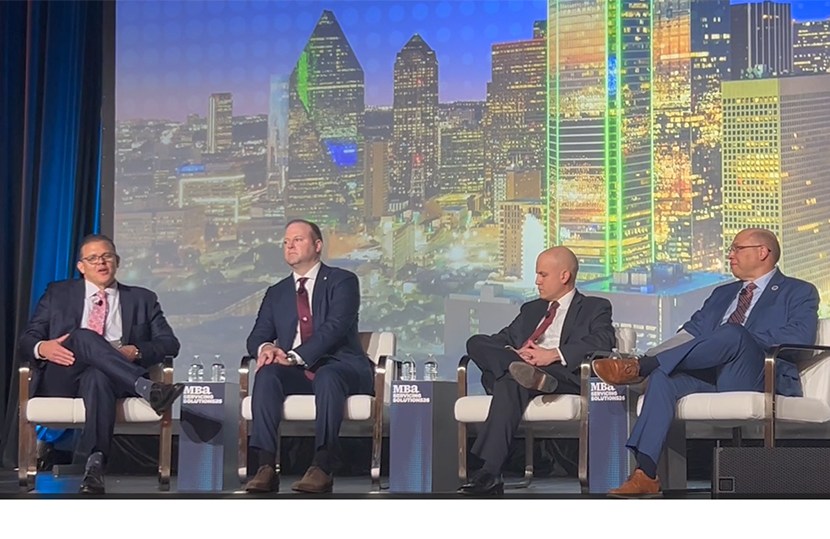
(From left: Owen Lee, Frank Cassidy, Joseph Gormley and Patrick Zondervan, by Anneliese Mahoney)
GRAPEVINE, Texas–Efficiency, liquidity and education were top themes when three federal housing officials took the stage to discuss their accomplishments so far and priorities moving forward at the Mortgage Bankers Association Servicing Solutions Conference and Expo Feb. 17.
“We’ve been focused on making FHA more efficient, making it easier for lenders and servicers to do business with FHA,” said FHA Commissioner Frank Cassidy, reflecting on his priorities roughly a year in. “There’s been so much bureaucratic red tape put in place over the years, and we’re focused on identifying areas within all FHA loan programs where we can pull that back, and then hopefully doing business with FHA is easier.”
2026 MBA Chair-Elect Owen Lee, also CEO of Success Mortgage Partners, asked Cassidy for any further updates on the loss mitigation waterfall. Cassidy noted that FHA is watching the data closely–acknowledging that there’s been some upticks in delinquencies–but is generally optimistic about the progress and the money that will be saved as a result.
Cassidy also said that the FHA is still exploring ways to reimburse servicers more quickly for advances. “We want to be better partners to our stakeholders, to the servicers, to the lenders,” he said.
Ginnie Mae President Joseph Gormley highlighted changes to Ginnie Mae’s liquidation reporting requirements to more closely align with the GSEs. As a No. 1 priority, he also pointed to a “loan-level initiative” currently in progress.
“What we are really interested in doing is increasing the velocity of our change toward a loan-level operation, much the way the conventional market operates today,” he said, noting that Ginnie Mae has issued mortgage-backed securities for over 50 years. Gormley said that Ginnie Mae is currently in an assessment phase for that effort.
Gormley noted that Ginnie Mae is a “larger segment of the market than we ever have been in the past,” driven by the popularity of the FHA and VA programs. “We are continuing to look at solutions that make our platform stronger, more resilient, bringing in additional liquidity, private capital, to make the programs stronger,” he said.
In terms of liquidity, Gormley said that, in addition to the effort regarding loan-level sales, he pointed to an interest in tweaking the acknowledgement agreement that many issuers have with Ginnie Mae in both the forward and reverse spaces.
Patrick Zondervan, executive director of loan guaranty service for the Department of Veterans Affairs, listed the partial claims effort as a top priority. He said that the VA is currently developing policy and is preparing to brief members of Congress soon.
Lee asked Zondervan about the now-ended VASP program–specifically how servicers should treat interim interest included in the purchase price of VASP loans. Zondervan said that the VA agreed to the prices as they were previously and isn’t going to take any retroactive action on those loans at this point. However, he noted that VA is doing an audit, and if any discrepancies are found, they’ll address that.
In terms of other reflections on the VASP program, Zondervan said the VA “learned a lot,” including efficient uses of technology. He also said the VA started with smaller batches so the servicers could engage more and correct some errors upfront. And, he said the VA invested in industry training.
“We did an audit after the fact and the error rate was much lower than we had anticipated,” Zondervan said.
Zondervan also described as a priority education for veterans and industry members–such as lenders, servicers and real estate agents–who work with them. He said he wants more veterans to choose VA loans, as “it’s one of the greatest benefits, […] and we certainly want to encourage them to use it.”
