

MBA Economists Break Down What Servicers Should Know
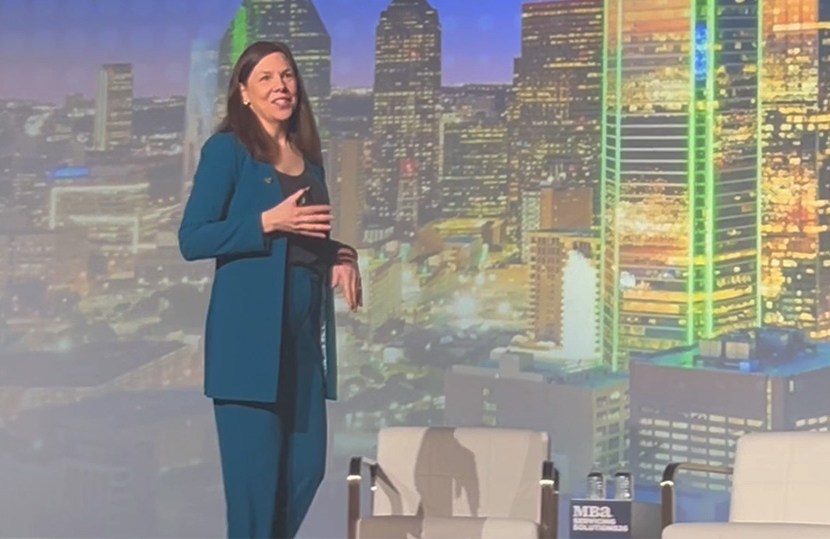
(Marina Walsh, by Anneliese Mahoney)
GRAPEVINE, Texas–MBA’s Deputy Chief Economist Joel Kan and Marina Walsh, CMB, MBA vice president of industry analysis, took to the main stage at MBA’s Servicing Solutions Conference and Expo Feb. 18. to address their economic outlook and how that impacts mortgage servicing–including that product mix, staffing and performance by loan type are all factors for servicers to watch right now.
On a macro level, the economy has a few different “storylines” affecting the market, Kan said. Consumer spending and growth have been solid but “we’ve also seen data that indicate this growth is not even. It’s pretty uneven across different households in terms of income, employment status, etc..,” Kan said.
Kan noted that certain types of credit products–such as auto loans, credit cards and student loans–are seeing rising delinquency rates, signs of strains for some households.
As for jobs, it’s also a mixed environment, Kan said. “The overall picture does show some strength, but also some signs that you have parts of the economy that are weakening,” he stated.

We’ve had waves of refinancing as rates have moved up and down–even minorly–and that’s likely to continue, Kan said. Other trends include an increase in adjustable rate mortgages.
Mortgage delinquencies are ticking up, said Walsh, noting that MBA recently released its national delinquency survey. There’s a bit of a mixed picture here, too, though. At 4.26% in Q4, delinquencies are tracking below the long-term average. Moreover, FHA delinquencies are notably higher than conventional.
Foreclosure inventory is also up, but still below long-term averages. That metric is also reflecting a significant gap between the FHA and VA loans and conventional loans.
There are lots of additional factors servicers should consider as they look at their portfolios, Walsh said, including the vintage, the regional or local market, stress caused by insurance and property taxes, and whether loans have previous workouts.
In terms of MBA’s forbearance study–which began during the COVID-19 pandemic–Walsh said there’s an increase in forbearance being given for temporary hardship, compared with last year’s more common natural disaster-related causes. But there’s an important question worth asking, she said: “Are these hardships truly temporary or not?”
Servicer operational performance over the past few years has been good, Walsh said, but there are opportunities and challenges firms need to be mindful of as we enter a new environment.
Recapture is a potential opportunity, she said. “With the trigger leads legislation effective next month, it’s going to be an even more important part of the servicer equation of bringing value to organizations,” Walsh said, explaining that currently recapture is sitting at 20%.
When it comes to staffing in this environment, Walsh noted that servicers need to be thinking about who they have on their payrolls and how they are going to manage their operations in a potentially higher default environment
“We have new staff coming in, and it’s going to require training and there’s going to be a learning curve involved,” she said.
Product mix is changing too, she said, with potentially more ARMs, HELOCs, Non-QM and other non-agency products, in addition to loans that have already been through multiple workouts. That may require different costs, new technology or better information to work with all these different types of borrowers.
“Servicing is never boring,” Walsh noted.
