

Broeksmit: A Strong Start to 2026–And Strong Words Regarding Credit Reporting #MBAIMB26
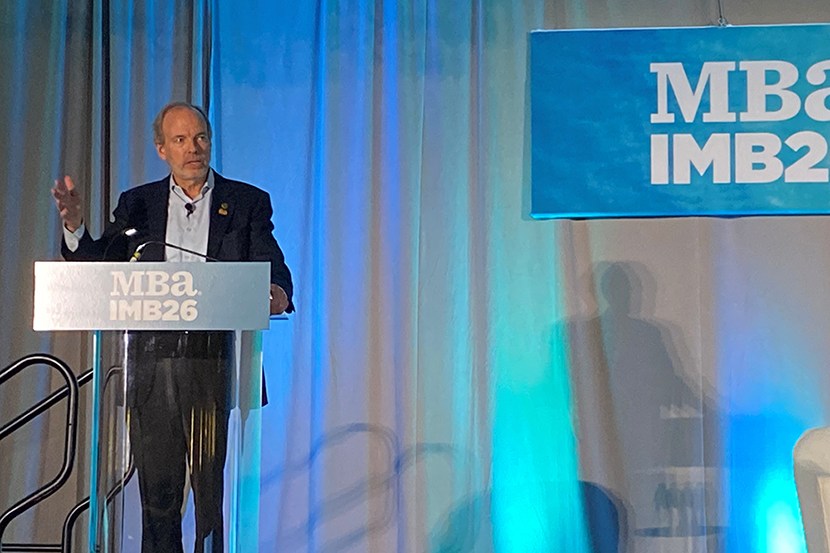
AMELIA ISLAND, Fla.–While many people relaxed in December, the Mortgage Bankers Association was on a tear–including tackling the important issue of credit scores and credit reporting–MBA President and CEO Bob Broeksmit, CMB, said here at MBA’s Independent Mortgage Bankers conference.
“We met with Office of Management and Budget Director Russell Vought and Mark Calabria at the White House, FDIC Chairman Travis Hill, Comptroller of the Currency Jonathan Gould, Fed Vice Chair for Supervision Michele Bowman, Rep. Mike Flood, Fannie Mae Acting CEO Pete Akwaboah and Co-Presidents Brandon Hamara and John Roscoe,” Broeksmit said. “This supplemented frequent communications with FHFA Director Bill Pulte on credit reporting and other issues.”
“Not quite two weeks ago, some of these individuals, along with National Economic Council Director Kevin Hassett, joined us for our CEO Exchange along with executives from 28 MBA member companies. Under Secretary for Domestic Finance Jonathan McKernan also joined us for a great off-the-record exchange of viewpoints. There was an energetic back-and-forth and we got some great feedback that will position us well for what’s ahead,” Broeksmit added.
Broeksmit spoke passionately about MBA’s advocacy for ending the tri-merge and moving to a single-file reporting structure for certain loans. He said the Consumer Data Industry Association–the trade group that represents the three major credit reporting agencies–argues for continuing the government-granted rents their members collect on every mortgage transaction and opposes the idea that individual credit report providers should be subject to market competition.
He asked if the CDIA was “gaslighting” mortgage bankers. “I’ve never really known how to define ‘gaslighting,’ but I know it when I see it,” he said. “One definition of gaslighting is acts by a person in a position of power designed to manipulate others to doubt themselves or question their own sanity. Tactics include denial, shifting of blame, minimizing, discrediting, and deflecting.”
“Well, we’ve just witnessed a master class in gaslighting by CDIA,” Broeksmit continued. “Ignoring that their members have a massive financial stake in preserving the status quo of the tri-merge credit report, a government-granted oligopoly that permits rampant and unchecked price increases, they have the audacity to claim that our proposal to permit a single in-file on GSE loans with credit scores of 700 or above is ‘a proposal that protects lender profits’ and that ‘we shouldn’t put taxpayers at risk just to save mortgage companies a few dollars on their bottom line’.”
“Here’s an especially rich claim, coming from the bureaus that profit handsomely from a privileged market position that shields them from competition: They say that it is ‘difficult to imagine lenders passing these purported savings directly onto consumers.’ This is a patently offensive and ignorant argument from companies that operate under a government-granted oligopoly,” Broeksmit said.
Broeksmit noted mortgage origination is one of the most competitive financial service products on the market, with thousands of originators competing every day for scarce purchase loans and refinances in the midst of the toughest market conditions in decades. “Meanwhile, the credit bureaus, immune from any competition, continue to report year-over-year revenue growth in their mortgage verticals,” he said. “The competitive market–a foreign concept to the bureaus–will ensure that reductions in mortgage origination costs will be passed on to consumers, both in the actual cost of the credit report on the closing statement and in the reduced overhead cost of credit reports paid for by lenders for loans that do not close.”
Regarding one CDIA argument about risk to the GSEs, Broeksmit noted Fannie Mae and Freddie Mac produce loans with “pristine” credit quality. “Recent public reports show their average credit score is 757, that 75% of their loans have credit scores over 740, and that only 6% have scores below 680. From a risk-management perspective, continuing to require three in-files and three scores on every borrower has long been an anachronism.”
Broeksmit added that no one needs to take his word for this. “In October of 2022, FHFA–responsible for supervising and conserving the assets of Fannie Mae and Freddie Mac–determined that the tri-merge was overkill. It approved moving to a bi-merge for all GSE loans. Our proposal for a single in-file guards against excessive risk-taking by setting a 700 credit score floor and permitting lenders to pull two or three reports and scores at their option,” he said.
The CDIA has said lenders are permitted to charge consumers upfront for credit reports, but Broeksmit said the bureaus do not interact with consumers at the point of sale, “and I doubt it would be a winning strategy for a lender to say to a prospective consumer who asks about mortgage products and interest rates ‘give me your credit card number to pay for a credit report and then I’ll quote you a rate.’ It would also render consumer shopping for the best mortgage rate completely cost-prohibitive,” he said.
“I could go on and on, but I’ll just leave you with those howlers from this exquisite piece of gaslighting,” Broeksmit added. “Anytime CDIA or the bureaus–who you’ll remember fought our successful effort to end the scourge of trigger leads tooth and nail–ever want to have a serious and constructive dialogue, count me in.”
“We even agree on one point, which is that competition in the credit scoring space would be a positive development. Of course, the entity that would provide said competition is–wait for it–owned by the three bureaus,” Broeksmit concluded. “Until then, enough with the nonsense.”
